

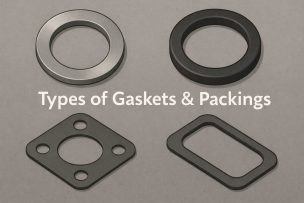
From O-rings to flange gaskets, gaskets and packings are widely used sealing materials. Do you know how many types exist and how they differ?
This page explains common gasket and packing types by shape, along with key features and typical applications.
Types of Gaskets
A gasket is a sealing material used in static (non-moving) joints to maintain airtightness or liquid-tightness.
Gaskets range from simple sheet gaskets punched out of gasket material to specially molded gaskets with complex cross-sections.
Below are typical gasket types, with their features and common uses.
Compressed Fiber Sheet Gasket (Joint Sheet Gasket)

Public domain, Link
A joint sheet gasket is a type of punched gasket made from a calendered and vulcanized sheet produced by mixing fiber materials with fillers and rubber.
In actual use, the sheet is punched into a ring or flange shape to match the sealing surface.
Rubber Sheet Gasket

Public domain, Link
A rubber sheet gasket is also a punched gasket, cut from sheet rubber materials such as natural rubber, NBR (nitrile rubber), butyl rubber, silicone rubber, fluoro rubber (FKM), and others, then formed into rings or flange shapes.
Tri-Clamp (Ferrule) Gasket / Sanitary Gasket
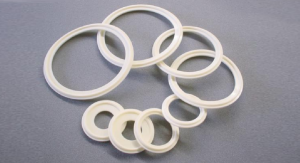
A ferrule gasket is designed specifically for ferrule (sanitary / tri-clamp) fittings. It has a “kamaboko”-like raised section that fills the fitting groove and helps ensure proper sealing at the contact surfaces.
Common materials include NBR, silicone rubber, EPDM, fluoro rubber (FKM), and PTFE.
It may also be called a ferrule packing, sanitary gasket, or sanitary packing.
Spiral Wound Gasket (Semi-Metallic Gasket)

Public domain, Link
A spiral wound gasket is made by alternately winding a V-shaped thin metal strip and a soft filler material into a spiral.
Compared with rubber or resin gaskets, it can seal under higher temperature and higher pressure conditions. It generally requires higher bolt torque to compress properly.
Metal Jacketed Gasket

Public domain, Link
A metal jacketed gasket has a core material covered (jacketed) with metal. It is used in high-temperature/high-pressure conditions where soft materials such as rubber or resin cannot be used.
Because the sealing surface is metal, strong compression (tight bolting) is generally required, similar to spiral wound gaskets.
Ring-Type Metal Gasket (Ring Joint / “Metal Joint”)

Public domain, Link
A metal joint (ring-type metal gasket) is a gasket machined from metal into a ring shape. It is used under high temperature and high pressure where soft gasket materials are not suitable.
Thread Seal Tape (PTFE Tape)

By Miya.m – Miya.m‘s photo, CC BY-SA 3.0, Link
Thread seal tape is a tape-type gasket made from PTFE (polytetrafluoroethylene, often known as Teflon).
It is wrapped around male pipe threads. The tape fills the clearance between male and female threads to maintain airtightness and prevent leaks.
Liquid Gasket (Liquid Sealant)
A liquid gasket is a liquid sealant used to prevent leakage in piping and flanged/ threaded joints.
It is applied to flange faces or threads, then cures to fill gaps at the joint and maintain tightness.
Types of Packings
A packing is a sealing material used in dynamic (moving) applications to maintain airtightness or liquid-tightness.
Packings include gland packing (wrapped around shafts) and oil seals installed on the bearing/housing side.
Below are typical packing types, with their features and common uses.
Gland Packing

By Miya.m – Miya.m‘s photo, CC BY-SA 3.0, Link
Gland packing is wrapped around a rotating shaft. A braided, rope-like packing is inserted between the shaft and the stationary housing to control leakage.
Because it is often used on rotating parts, lubricity is important to reduce friction and heat generation.
Mechanical Seal

By Miya.m – Miya.m‘s photo, CC BY-SA 3.0, Link
A mechanical seal is used on rotating parts of pumps, cylinders, and other equipment handling liquids, providing tight sealing with sliding seal faces.
Oil Seal

By Miya.m – Miya.m‘s photo, CC BY-SA 3.0, Link
An oil seal seals the bearing/housing area on the outside of a rotating shaft.
In pumps and cylinders, it is installed to prevent internal lubricating oil from leaking.
In simple terms, gland packing seals on the shaft side, while oil seals seal on the housing/bearing side—the sealing points differ.
Other Gaskets & Packings
O-Ring

Public domain, Link
An O-ring is a ring-shaped seal with a circular (O-shaped) cross-section. It seals by being compressed—flattening the circular cross-section when clamped in a groove or between surfaces.
This type of seal is used in both static and dynamic applications. For that reason, it can be classified as either a gasket or a packing; here it is listed as “other.”
O-rings come in many materials depending on the application, including NBR, silicone rubber, fluoro rubber (FKM), urethane rubber, butyl rubber, and more. Metal O-rings also exist for special conditions.
Conclusion
Gaskets and packings are available in many shapes and materials depending on the sealing requirement.
When selecting a seal, choose the type that best matches the fluid, temperature/pressure conditions, movement (static vs. dynamic), and the joint design.