

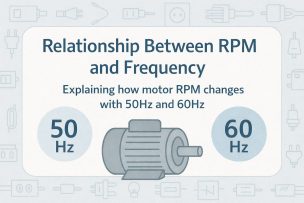
The rotational speed of an electric motor is determined by the power supply frequency (Hz).
In Japan, 50 Hz and 60 Hz regions coexist, so when relocating equipment or installing imported machines, differences in motor speed can become a serious issue.
This article explains the relationship between speed and frequency, the synchronous speed formula, and what actually changes between 50 Hz and 60 Hz in a clear, beginner-friendly way.
Basic Relationship Between Speed and Frequency
For a three-phase induction motor, the rotational speed (synchronous speed) is determined by the following equation:
Synchronous speed (min⁻¹) = 120 × Frequency (Hz) ÷ Number of poles
Example: 4-pole motor
- 50 Hz: 1500 min⁻¹
- 60 Hz: 1800 min⁻¹
In a real induction motor, there is slip, so the actual operating speed is slightly lower than the synchronous speed.
50 Hz vs. 60 Hz (Example: 4-Pole Motor)
| Item | 50 Hz | 60 Hz |
|---|---|---|
| Synchronous speed | 1500 min⁻¹ | 1800 min⁻¹ |
| Typical actual speed | Approx. 1430–1480 | Approx. 1720–1760 |
| Rotational torque | Slightly higher | Slightly lower |
| Heat generation | Lower | More likely to increase |
Because 60 Hz results in higher motor speed, the same machine may change as follows:
- Pumps → Higher flow rate (often up to ~30% increase)
- Fans → Higher airflow and static pressure
- Conveyors → Faster transport speed
- Machine tools → Higher spindle RPM
Speed Comparison by Number of Poles
| Number of poles | 50 Hz | 60 Hz |
|---|---|---|
| 2-pole | 3000 | 3600 |
| 4-pole | 1500 | 1800 |
| 6-pole | 1000 | 1200 |
| 8-pole | 750 | 900 |
The more poles a motor has, the lower the speed.
What Happens When Frequency Changes?
① Changes in machine performance
As rotational speed increases:
- Pumps → Flow rate and head increase
- Fans → Airflow and pressure increase
- Conveyors → Speed increases
If this exceeds the machine’s design limits, it can lead to overload, increased noise, and increased vibration.
② Changes in current and heat generation
At 60 Hz, motor current often tends to increase depending on the load, which can result in higher heat generation.
③ Impact on equipment lifetime
Rotating components such as bearings and seals generally wear faster at higher speeds.
④ Notes for imported machines
If a machine designed for 60 Hz is used in a 50 Hz region, issues such as the following may occur:
- Lower speed → Insufficient performance/capacity
- Insufficient torque → Failure to start
- Overload → Abnormal shutdown/trip
How to Compensate for Frequency Differences
① Use an inverter (VFD)
This is the most common and reliable approach.
- Even in a 50 Hz region, you can adjust speed to match 60 Hz-equivalent operation
- Effectively solves frequency mismatch during equipment relocation
② Replace the motor with a dual-frequency model
In factories, 50/60 Hz compatible motors are widely used.
③ Change pulley ratio or gear ratio
A common approach for rotating machinery. Whether it is feasible depends on the structure and design of the equipment.
Recommended Books
- Practical Fundamentals of Electric Motors
- Basics of Frequency and Power Conversion
- Introduction to Rotating Machinery Engineering
Conclusion
Motor speed is determined by power supply frequency and the motor’s number of poles.
- 50 Hz → Lower RPM
- 60 Hz → Higher RPM
- Pumps and fans can change flow significantly
- Be cautious when relocating or importing equipment
In most cases, frequency mismatch issues can be effectively solved with inverter (VFD) control.