

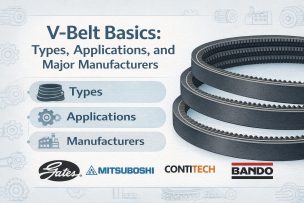
A V-belt is an industrial power transmission belt with a trapezoidal (V-shaped) cross section. It transmits power by engaging with pulleys.
By utilizing friction efficiently, V-belts can transmit power reliably and are widely used in applications ranging from industrial machinery and automobiles to HVAC systems.
This article explains the fundamentals of V-belts, their types and standards, as well as major manufacturers and where to purchase them.
What Is a V-Belt? (Basic Overview)
A V-belt has a trapezoidal cross section that fits securely into the groove of a pulley, generating high frictional force.
Because it resists slipping and offers high efficiency, the V-belt is one of the most widely adopted power transmission methods.
Types of V-Belts (Cross-Section Standards)
V-belts are classified by cross-section size based on standards such as JIS and ANSI.
- Type A, B, C: Commonly used cross sections. Type A is used for small machines, B for medium-sized equipment, and C for large machinery.
- Type M: Narrow V-belts used in compact devices and household appliances.
- 3V, 5V, 8V: Narrow V-belts based on overseas standards. They offer high efficiency and enable space-saving designs.
Types of V-Belts (By Grade and Application)
Even with the same cross section, multiple grades exist depending on material and construction.
- Standard V-belts: The most common type, offering high versatility for a wide range of applications.
- Heavy-duty (reinforced) V-belts: Improved rubber compounds and tensile cords provide better heat and wear resistance.
- Energy-saving V-belts: High-efficiency belts designed to reduce power loss.
Examples: Mitsuboshi Belt “Maxstar Wedge Belt,” Bando Chemical “e-power V-belt” - Variable-speed belts: Used to change pulley diameter and adjust rotational speed.
- Double V-belts: V-shaped on both sides, used in special layouts.
Applications of V-Belts
- Machine tools and industrial motors
- HVAC equipment (blowers, compressors)
- Automotive auxiliary drives
- Agricultural machinery
- Conveying systems
Major Manufacturers and Their Features
Mitsuboshi Belt
The largest domestic manufacturer in Japan. Offers a wide lineup from standard V-belts to energy-saving models such as the “Maxstar Wedge Belt.”
Official website
Bando Chemical
Well known for automotive auxiliary drive belts and widely used in industrial applications. Provides high-efficiency products such as the “e-power V-belt.”
Official website
Gates
A global belt manufacturer originating in the United States. Strong in narrow V-belts and high-efficiency designs, widely adopted overseas.
Official website
Manufacturer Comparison Table
| Manufacturer | Key Features | Main Applications |
|---|---|---|
| Mitsuboshi Belt | Wide range of standards, energy-saving “Maxstar” series | Industrial, agricultural, HVAC |
| Bando Chemical | Automotive auxiliary drives, energy-saving “e-power” series | Automotive, FA equipment |
| Gates | Strong in international standards (3V, 5V, etc.) and narrow V-belts | Precision machinery, industrial equipment |
Where to Buy Online
Search on Amazon
Search on Rakuten
Search on Yahoo! Shopping
Q&A
Q. What is the difference between a V-belt and a timing belt?
A. A V-belt transmits power by friction, offering quiet operation and flexibility. A timing belt has teeth and does not slip, enabling highly precise power transmission.
Q. When should a V-belt be replaced?
A. Replacement is required if wear, cracks, or belt noise occur. In general, periodic replacement is recommended after several thousand hours of operation.